

Why Families Have More Photographs Than Ever and Less to Show for It
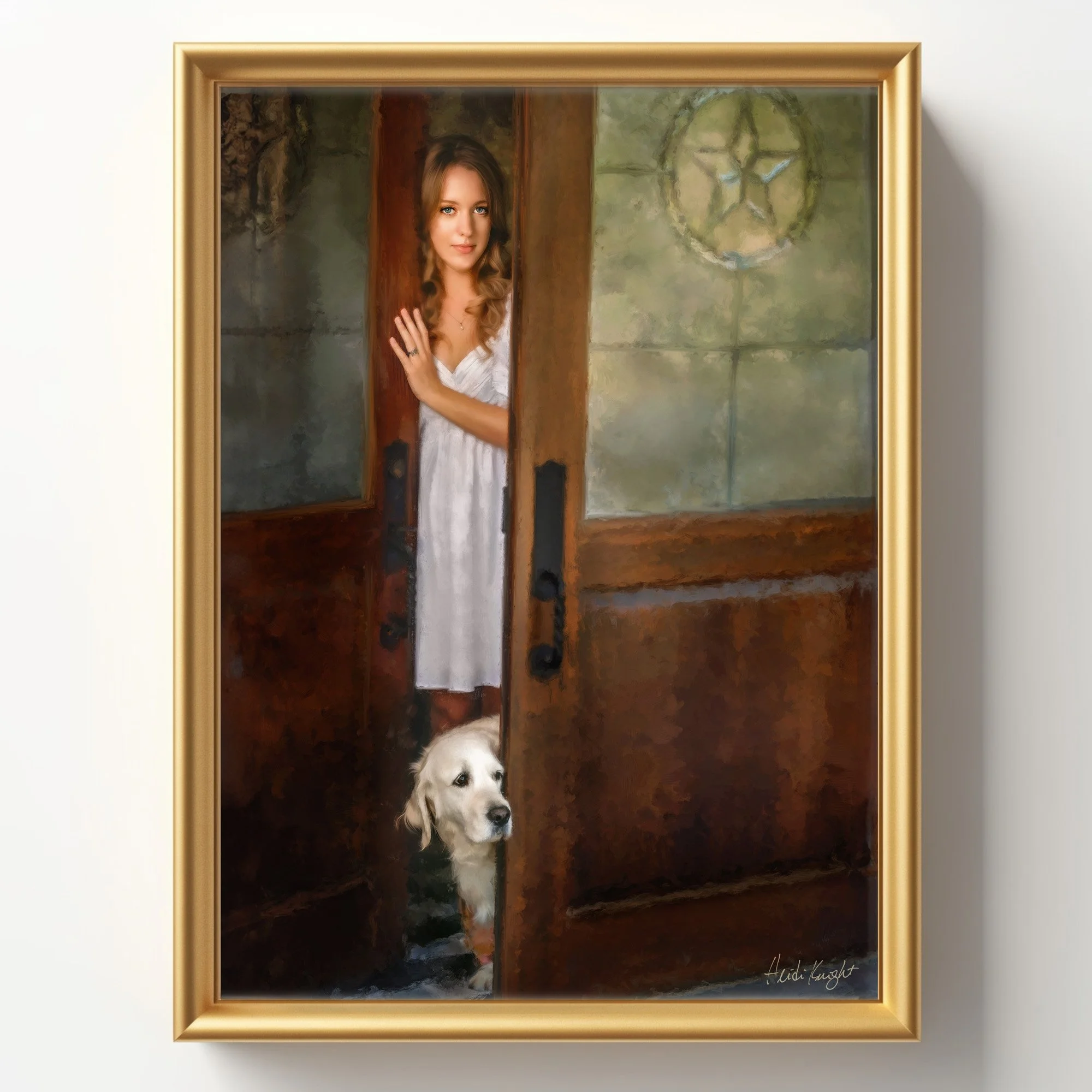
Welcome Home, a Heidi Knight Original featuring a high school senior and her family's English Cream Golden Retriever. While thousands of photographs may document a childhood, a single portrait can preserve the moments and relationships that define it.
I recently came across an article discussing how smartphones have changed the way we remember our lives. It made me think about something I see every day.
No generation in history has photographed childhood more thoroughly than we do now. Parents document everything from first smiles and first steps to vacations, school programs, birthdays, and countless ordinary moments in between. Most families carry a camera everywhere they go, and many have tens of thousands of photographs stored on their phones.
Yet when I walk into most homes, I rarely see those memories reflected on the walls.
Previous generations displayed family history differently. They kept albums on coffee tables, framed portraits in hallways, and photographs on mantels and bookshelves. Family stories were visible. Children grew up surrounded by images of parents, grandparents, and earlier chapters of their own lives.
Today, much of that history lives inside a device.
The irony is hard to ignore. We have more photographs than any generation before us, yet many of those images may never be viewed again after the day they are taken. They sit buried beneath years of screenshots, text messages, vacation snapshots, and videos, slowly disappearing into digital storage.
The problem is not that we are taking too few photographs. In fact, most families are doing an excellent job documenting childhood. The challenge is that documenting and preserving are not the same thing.
After more than twenty-six years working with children and families, I have learned that childhood moves much faster than parents expect. While we are living through those years, they often feel endless. Then suddenly the baby who could not sit independently is running through the house. The preschooler who wanted to hold your hand everywhere becomes a confident elementary school student. Before long, the child you tucked into bed every night is preparing for high school graduation.
Parents often believe they will remember every detail. Most eventually discover that memory has a way of softening the edges. We remember the feeling of those years, but many of the small details fade more quickly than we realize.
That is where photographs become important. Not because they freeze time, but because they preserve details that memory alone cannot hold onto forever.
Still, not every photograph serves the same purpose. Snapshots document daily life. They capture moments, milestones, and memories as they happen. Every family should have thousands of them.
Portraits serve a different role. They become landmarks. They help define a season of life and preserve it in a way that is meant to be seen, enjoyed, and remembered.
A photograph hidden inside a camera roll cannot become part of a family's daily experience. A portrait displayed in a home can. Children pass it every day. Guests stop and look at it. Years later, it becomes part of the story people tell about who they were and what mattered to them.
Technology will continue to change. Phones will be replaced. Cloud services will come and go. Storage formats will evolve. The images that survive from one generation to the next are often not the ones that were taken. They are the ones that were valued enough to preserve.
That is why I believe every family needs both. Thousands of photographs to document life as it unfolds, and a handful of meaningful portraits that rise above the rest.
One day those portraits will matter for reasons that have nothing to do with photography. They will become reminders of relationships, personalities, seasons of life, and the people who filled a home with laughter, chaos, and love.
The goal is not to take fewer photographs. The goal is to make sure the most important ones do not get lost among the thousands.
Considering Commissioned Artwork?
The Heirloom Portrait Guide answers the questions most families have before commissioning artwork, including scale, investment, timeline, and what to expect throughout the process.
